The HYDRALAB+ project ended in August 2019

Experiments by Invited Researchers
Wave transformation on a low-sloping beach
| Project acronym: | HyIV-Deltares-09 |
| Name of Group Leader: | Dr. Hervé Michallet |
| User-Project Title: | Wave transformation on a low-sloping beach |
| Facility: | Schelde Flume |
| Proceedings TA Project: | GLOBEX: WAVE DYNAMICS ON A SHALLOW SLOPING BEACH |
| Data Management Report: |
Report |
User-Project Objectives
The overall aim of GLOBEX is to improve our understanding of the non-linear water motion on gently sloping beaches. To that end, GLOBEX focuses on three aspects of wave non-linearity on a fixed 1:80 sloping beach: (1) Infragravity waves. The objective is to identify the physical mechanism(s) leading to infragravity-wave dissipation, a recently discovered aspect of infragravity wave dynamics found solely on gently sloping beaches. Experiments will consider random short waves, bichromatic waves and monochromatic long waves. The recorded data will also be used to test and improve the capabilities of advanced hydrodynamic models in predicting infragravity-wave hydrodynamics. (2) Non-linear wave propagation. The objective is to test and improve existing predictors of non-linear wave celerity, crucial to wave-transformation and hydrodynamic models. Wave celerity estimates will be provided by the analysis of video-recordings and inferred from the water-surface elevation measurements. Particular attention will be paid to obtain accurate measurements in the inner surf and swash zones, where non-linearity is presumably largest and current predictors perform rather poorly. (3) Boundary-layer dynamics. The objective is to extend our knowledge on boundary-layer dynamics, with a focus on non-linear boundary layer streaming and the vertical structure of velocity skewness and asymmetry. Various acoustic and optical instruments will be used in concert to quantify the variations in velocities in the water column, including the very thin wave bottom boundary layer.
Short description of the work carried out
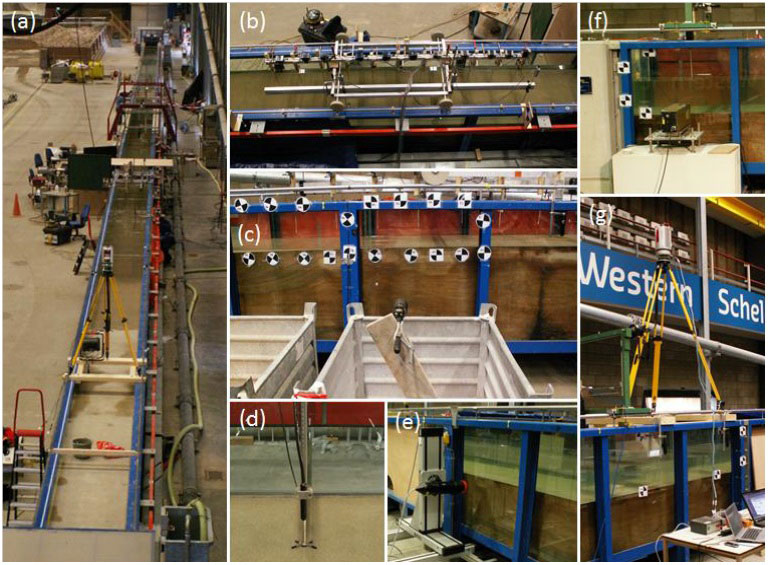
Achievements: (1) data set of sea-surface elevation and near-bed velocity of random, bichromatic and monochromatic waves that is unique in terms of spatial resolution (0.074-0.75 m) and extent (from the wave maker into the swash zone) and of temporal resolution (128 Hz) and duration (just over an hour). (2) extensive supportive measurements with video cameras and a terrestrial laser scanner. (3) detailed vertical flow profiles at two locations in the flume. All data were synchronized to result in one complete data set. (4) extensive hands-on training in planning, data acquisition and data processing for young (PhD) scientists. Difficulties: (1) Substantial cross-mode activity in the runs with bichromatic and monochromatic short waves. Ad-hoc attempts to remove cross-modes were unsuccessful.
Highlights of important research results
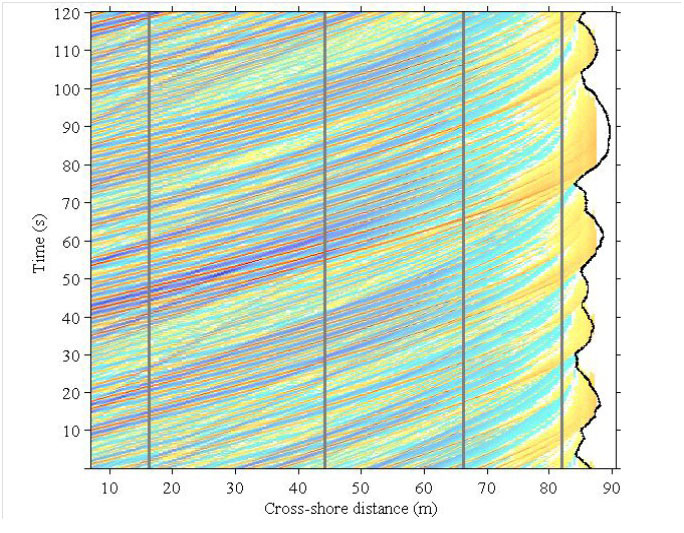
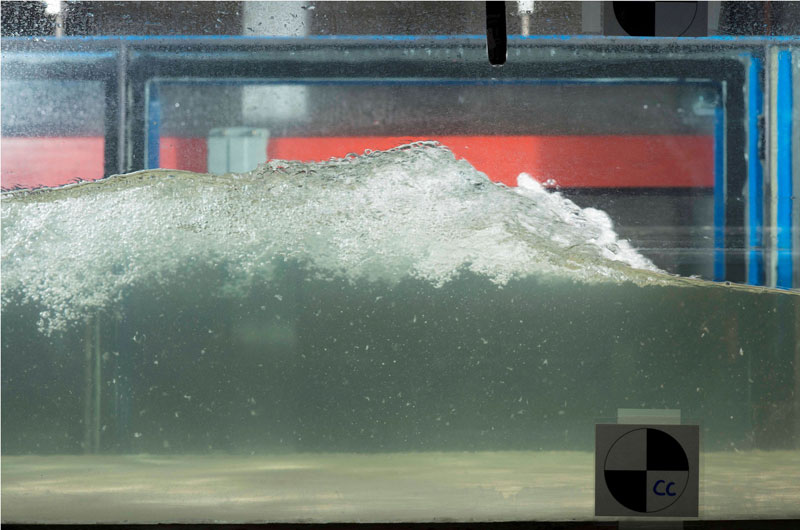
On the 1:80 sloping beach: (1) incoming infragravity waves loose a substantial part of their energy. Preliminary analysis suggests that this dissipation is due to infragravity wave breaking and non-linear energy transfer from high- to low infragravity frequencies. (2) the celerity of individual waves can vary by 90% of the mean celerity over the duration of a wave group. The variability depends on the relative infragravity-wave surface elevation (with respect to the mean water depth), and is therefore maximum when approaching the swash zone. Moreover, individual short waves converge toward the infragravity-wave crest while propagating through the surf zone. (3) vertical profiles of short-wave velocity skewness and asymmetry remain constant in the free-stream but rapidly change within the boundary layer. For all conditions the velocity asymmetry decreases within the boundary layer, while the skewness increases. A linear relationship seems to exist between the near-bed velocity skewness and the velocity asymmetry and skewness in the free-stream. (4) swash-swash interactions are important in controlling swash oscillations. (5) infragravity waves dominate the inner-surf and swash zone and, presumably, are of critical importance to the sediment transport in these zones.
| Publications |
| D.A. van der A, D. Mouaze, L. Vignal, P.A. Silva, T. Abreu, E. Barthelemy and H. Michallet
Wave boundary layer dynamics on o a low sloping laboratory beach
, 2013 Coastal Dynamics 2013 conference |
| Tissier, M., R. Almar, P. Bonneton, H. Michallet, F. Birrien, A. de Bakker and G. Ruessink
Individual wave celerity in the surf zone of a low-sloping laboratory beach
, 2013 Coastal Dynamics 2013 conference |
| Ruja, A., J.L. Lara, H. Michallet, N. Senechal, I.J. Losada
Transient swash motions on a gently-sloping beach
, 2013 Coastal Dynamics 2013 conference |
| Ruessink, G., H. Michallet, P. Bonneton, D. Mouaze, J.L. Lara, P.A. Silva and P. Wellens
GLOBEX: wave dynamics on a gently sloping laboratory beach
, 2013 Coastal Dynamics 2013 conference |
| Rocha, M.V.L., H. Michallet, P.A. Silva, T. Abreu and E. Barthelemy
Nonlinearities of short and long waves across the shoaling, surf and swash zones: physical model results
, 2013 Coastal Dynamcis 2013 conference |
| A. de Bakker, M. Tissier, V. Marieu, N. Senechal, A. Ruju, J. Lara and G. Ruessink
Infragravity wave propagation and dissipation on a low-sloping laboratory beach
, 2013 Coastal Dynamics 2013 conference |
| Almar, R., P. Bonneton, H. Michallet, R. Cienfuegos, G. Ruessink and M. Tissier
On the use of the Radon transform in studying nearshore wave dynamics
, 2013 Coastal Dynamics 2013 conference |