The HYDRALAB+ project ended in August 2019

Large Ice Model Basin (LIMB)
Hamburgische Schiffbau-Versuchsanstalt, HSVA
Karl-Ulrich Evers
Bramfelder Str. 164
D-22305 Hamburg
Germany
http://www.hsva.de/
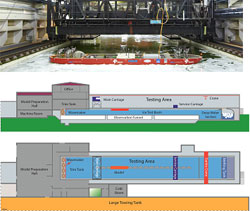
The Hamburg Ship Model Basin (HSVA) has been operating ice research facilities since 1972. The main feature is the 78 m long, 10 m wide and 2.5 m deep ice model basin. At the end of the ice tank a deep water section of 12 m x 10 m x 5 m is available.
Description of facility:
Technical data
| Large Ice Model Basin with Mobile Wave Generator | |
| Tank length: 78 m | |
| Tank width: 10 m | |
| Water depth: 2.5 m ( partially 5.0 m ) | |
| minimum air temperature: -20°C | |
| Ice growth rate: 2 mm/hour | |
| Shallow water bottom | |
| Adjustable for different water levels for the entire tank length | |
| Mobile Wave Generator | |
| Max. wave height (regular waves): 0.25 m | |
| Towing Carriage | |
| Speed range: 1 mm/s to 3000 mm/s | |
| Towing capacity: 50 kN | |
| Transverse Carriage | |
| Static load capacity (horizontal): 5 kN | |
| Static load capacity (vertical): 10kN | |
| Max. driving force: 3 kN at 0.5 m/s driving speed | |
| URL | |
| More information about LIMB: More information about LIMB: http://www.hsva.de/our-facilities/ice-tank.html |
The Hamburg Ship Model Basin (HSVA) has been operating ice research facilities since 1972. The main feature is the 78 m long, 10 m wide and 2.5 m deep ice model basin. At the end of the ice tank a deep water section of 12 m x 10 m x 5 m is available.
A mobile wave generator can be installed in the ice tank in short time when required and regular waves can be generated up to a wave height of 0.25 m.
A shallow water bottom covering the entire ice basin can be adjusted to simulate shallow water conditions (e.g. inland waterways). An air forced cooling system generates air temperatures as low as -20°C, by which the NaCl-doped water freezes at a rate of about 2 mm/hour. The mechanical ice properties of the model ice are correctly scaled in order to simulate the natural icebreaking processes. An advanced technique to improve the mechanical ice properties was developed and patented by HSVA. A motor-driven towing carriage spans the width of the tank and runs up to 3 m/s and provides a towing force of 50 kN.
A transverse carriage is installed as a sub-carriage to the towing carriage. Both carriages together make it possible to run fixed offshore structures or floating vessels in a combined and computer-controlled x-y-motion (planar motion) through the ice sheet. The new device gives the opportunity to simulate, for instance, ice drift scenarios with slow or rapid ice drift direction changes, whereby the model ice sheet is kept stationary.
The transverse carriage has a maximum static load capacity of 5 kN in any horizontal direction, and a load capacity of nearly 10 kN in vertical direction. The horizontal load can be applied on a vertical lever of up to 1.2 m length. A maximum driving force of about 3 kN is applied to the transverse carriage at speeds of up to 0.5 m/s by a geared electric motor.
Service carriages above water as well as underwater are available to carry experimental equipment, measuring devices e.g. a variety of load cells, dynamometers, accelerometers, and video cameras for surplus water and underwater.

Schematic of Large Ice Tank

Icebreaking tanker penetrating through level ice

Ridge penetration of an icebreaking vessel

Ice rubble formation on a shoulder ice barrier

Evacuation craft in drifting ice