The HYDRALAB+ project ended in August 2019

Experiments by Invited Researchers
Modelling Antarctic Flows
| Project acronym: | HyIII-CNRS-06-L |
| Name of Group Leader: | G. LANE-SERFF, University of Manchester UK |
| User-Project Title: | Modelling Antarctic Flows |
| Facility: | Coriolis platform |
| Proceedings TA Project: | Modelling antarctic flows |
| Data Management Report: |
Report |
User-Project Objectives
Summary:
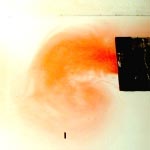
The dynamics of density-driven flows on sloping topography has been the object of a significant amount of recent study through laboratory experiments, numerical models and field observations. Under some circumstances such flows break up into eddies, inducing strong motion in overlying water, while the viscous draining part of the flow can produce “roll-waves”. The basic features and important parameters for these flows are now established, at least in broad terms.
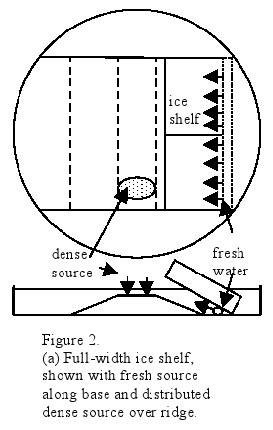
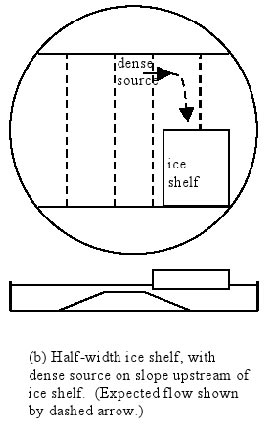
This type of flow occurs in the seas around Antarctica, contributing to the formation of the deepest water masses of the world’s oceans and thus important in the global thermohaline circulation. An extra complication in the Antarctic environment is the presence of ice shelves. These impose an upper boundary that is rather different from the usual free surface, and can result in sharp changes in water column depth. The purpose of this study is to investigate some of the basic types of flow including the effects of a modelled ice shelf. These will extend and compliment smaller scale laboratory work and numerical models, and help with our interpretation of data collected around Antarctica.
Click here for further information about this project on the CNRS website.