The HYDRALAB+ project ended in August 2019

Experiments by Invited Researchers
Generation of interfacial solitons by internal-wave beams
| Project acronym: | HyIII-CNRS-14 |
| Name of Group Leader: | T. Gerkema, ROYAL NETHERLANDS INSTITUTE FOR SEA RE |
| User-Project Title: | Generation of interfacial solitons by internal-wave beams |
| Facility: | Coriolis platform |
| Proceedings TA Project: | Generation of interfacial solitons by internal-wave beams |
| Data Management Report: | There is no Data Management Report available for this project |
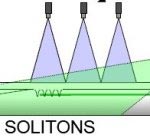
User-Project Objectives
Summary:
Internal waves in fluids owe their existence to the restoring forces of gravity (in a stably stratified fluid) and the Coriolis force (in rotating fluids). Examples are the inertio-gravity waves in the ocean, a special class of which are those at tidal frequency (internal tides), which are generated by barotropic tidal flow over largescale topography, such as the continental slope. Internal waves propagate not only horizontally but also vertically, the energy being usually concentrated in diagonal beams. In the ocean, it has been found that when such a beam impinges on the seasonal thermocline (a shallow layer where temperature decreases rapidly with depth), the beam may lose part of its energy to high-frequency solitary waves, so-called internal solitons [2,10,11,12]; this phenomenon is referred to as “local generation of solitons”. For this mechanism to occur, the vertical structure of the water column needs to be built up as follows: a constantly stratified lower layer, an upper mixed layer, and a sharp transition in density between the two. This sharp transition is called a pycnocline, and may be either due to strong temperature gradients (thermocline), as in the ocean, or salinity gradients (halocline), as in the experiments proposed here. Click here for further information about this project on the CNRS website.