The HYDRALAB+ project ended in August 2019

Brief Summary on developing surrogates biofilms
What is the FZK?
The Forschungszentrum Küste (FZK) is a Joint Central Institution of the Leibniz Universität Hannover and the Technische Universität Braunschweig. This institution aims at improving the co-ordination of coastal research at universities and developing multi-disciplinary national and international co-operation. The superordinate goal of the Forschungszentrum Küste is the scientific investigation of hydrodynamic, morphodynamic and ecological processes at the coast and in front of the coast. For more details please see:
https://www.fzk.uni-hannover.de/fzk_start.html?&L=1
Contribution of the FZK to Hydralab+/RECIPE
The FZK is involved in several tasks of the Hydralab+ project. On this webpage only task 8.5: “Innovative Approaches for scaling biology in time“ is briefly presented. One aim of task 8.5 is to develop surrogates for biota to be used in laboratory experiments in order to study the impact of biology on morphodynamic processes and the interactions with climate change. The FZK focuses here on the development of surrogates which mimic biostabilization processes mediated by biofilms.
Biofilms consist of microorganisms (e.g. microalgae, bacteria) and their secreted extracellular polymeric substances (EPS). The role of EPS in biostabilization is of great importance as EPS acts like a “natural glue” which sticks together single sediment grains and thereby increases the resistance of the bed to hydrodynamic forcing (e.g. Gerbersdorf & Wieprecht, 2015, see Figure 1).
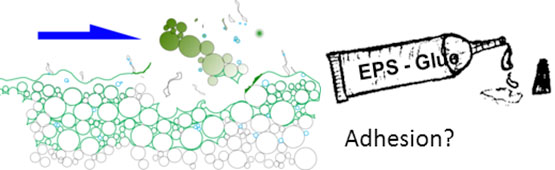
Figure 1 Left: Schematic illustration of erosion of a biostabilised layer of sediments due to hydrodynamic forces. Right: In biofilm mediated biostabilisation sediment grains are glued together by EPS.
Generally, the degree to which sediments are biostabilised depends on a number of environmental conditions: Light intensity, hydrodynamics, nutrient availability and seasonality. Moreover, biostabilization effects differ strongly for differently matured biofilms. As scaling down these biological processes is nearly impossible, laboratory experiments that consider the impact of biostabilization over longer periods of time are difficult to be conducted.
Therefore, an alternative to cultivating natural biofilms might be of great use. At the FZK we investigate the properties of so called rheology modifiers commonly used in the food industry, with the main goal to develop/modify adequate (i.e. mechanically similar) surrogates for natural EPS.
In this context, different laboratory measurements will be conducted to inter alia study the adhesiveness (“stickiness”), viscosity and density of such surrogates. Opposed to viscosity and density measurements where traditional equipment can be used, adhesion measurements require a more specialized and relatively young approach: Magnetic Particle Induction – Image Processing (MagPI-IP, based on an original idea presented in Larson et. al., 2009). Photographs of the measuring device are shown in Figure 2.
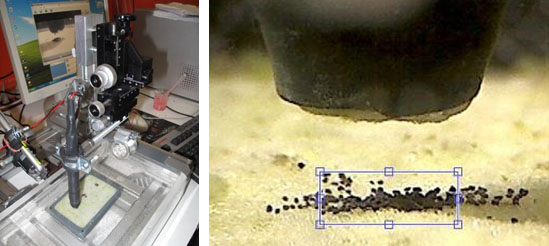
Figure 2 Left: The device to measure surface adhesion forces (MagPI-IP). It consists of a controllable electromagnet which attracts ferromagnetic particles spread on (and thus adhered to) a biofilm surface (for more information please see Thom et al., 2015). Right: A close-up of the tip of the electromagnet and the particles (in dark red) on a young biofilm surface. The particle size ranges between 0.1 and 0.2mm.
First results
So far the surface adhesion forces of four different potential surrogates (Xanthan Gum, Agar Agar, Sodium Alginate and Guar Gum) are determined at 4 different concentrations (0.3, 1.0, 1.5, 3.0 weight-%). It is found, that the adhesion-characteristics but also the structure of the surrogates differ largely indicating that each surrogate might be useful in a different experimental context.
However, a promising surrogate is Xanthan Gum (XG) as its adhesive properties could be well controlled by varying the concentration of XG powder mixed to water. In a first attempt to compare the results of adhesion measured on surrogate surfaces to that of “natural” biofilms (unpublished data ) it is demonstrated that the XG stickiness (at the reported concentrations) is well in line with values for young growing biofilms (see Figure 3). For example and according to Figure 3, XG mixed at a concentration of 1.0 weight-% (one gram powder dissolved in 1 liter of water) could be used to mimic the surface stickiness of a 3.5 weeks old “natural” biofilm (cultivated under very specific environmental conditions). This gives a first reference value for surrogate mixtures in future experiments to simulate biostabilisation.
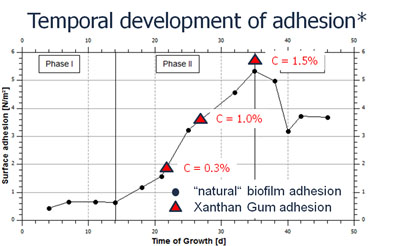
Figure 3 Generic plot on the development of surface adhesion of a “natural” biofilm (filled circles, cultivated under very specific environmental conditions) and a surrogate (Xanthan Gum, XG) at different concentrations. After day 35 the “natural” biofilm experiences a shift in its structure, which most probably cannot be modeled by XG.
Planned work
After conducting more studies on rheological parameters, we will focus on investigating possibilities to adjust the mechanical properties of the surrogate EPS during running experiments to e.g. simulate the impact of seasonality or climate change in physical experiments. Potential approaches include the adjustment of salinity/temperature or the addition of chemical substances.
Furthermore, physical experiments will be conducted to demonstrate a) the feasibility of using EPS surrogates to simulate long-term effects of biostabilization and b) develop protocols so that other laboratories are able to apply these methods.
Finally, we plan to develop a simplified version of the adhesion measurements to characterize the adhesiveness of a surface. This might be of great use for experimental work on biostabilization and help in selecting appropriate surrogates.
References
Gerbersdorf, S. U., & Wieprecht, S. (2015). Biostabilization of cohesive sediments: revisiting the role of abiotic conditions, physiology and diversity of microbes, polymeric secretion, and biofilm architecture. Geobiology, 13(1), 68–97. https://doi.org/10.1111/gbi.12115
Larson, F., Lubarsky, H., Gerbersdorf, S. U., & Paterson, D. M. (2009). Surface adhesion measurements in aquatic biofilms using magnetic particle induction: MagPI. Limnology and Oceanography: Methods, 7(7), 490–497.
Thom, M., Schmidt, H., Wieprecht, S., & Gerbersdorf, S. U. (2015). Biostabilization of fluvial sediments: An improved device to address an old problem. In E-proceedings of the 36th IAHR World Congress. The Hague, Netherlands.